
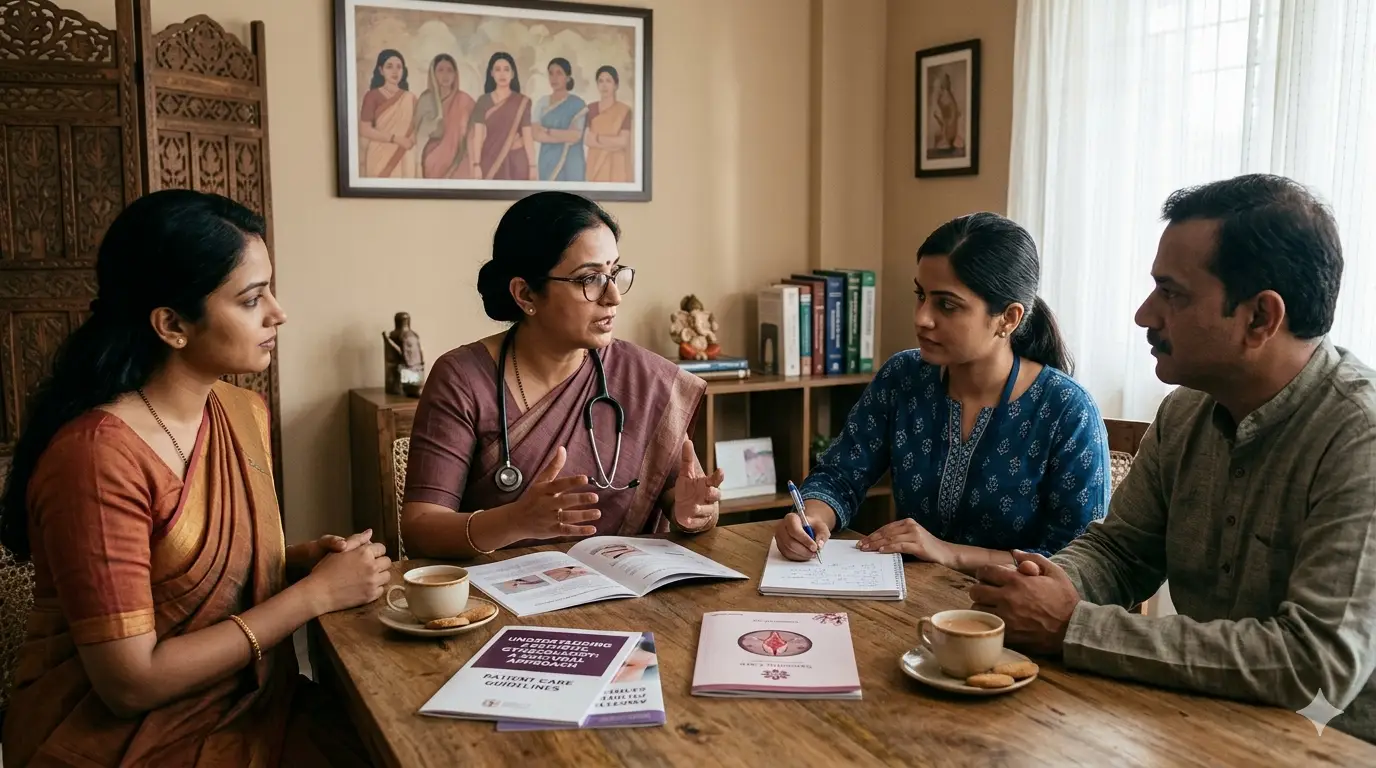

Clinical skill alone is not enough to practise aesthetic gynaecology well in India.
The conversations that happen in consultation rooms here are shaped by family dynamics, social expectations, modesty norms, and decades of silence around intimate health. A practitioner who ignores this context — no matter how technically skilled — will struggle to deliver meaningful care.
As specialists, we cannot simply take a “Western” textbook approach and apply it here. To be a successful aesthetic gynaecologist in India, you must be as skilled in Cultural Nuance as you are with a CO2 laser. Here is how we bridge that gap.
Here is what cultural competence actually looks like in this specialty, and why it matters as much as your clinical training.
Table of Contents
1. Understanding Why Patients Wait So Long
Many women in India live with functional gynaecological concerns for years — sometimes decades — before seeking help. Labial hypertrophy, post-pregnancy pelvic floor changes, vaginal laxity, and genitourinary symptoms after menopause are common. But they are rarely discussed.
The barrier is not access. It is shame.
Research published in PMC on the psychological impact of taboos around female sexuality in developing nations found that social stigma is a primary driver of delayed gynaecological care, independent of education level or socioeconomic status. Women report fear of judgement — from family, from community, and sometimes from healthcare providers themselves.
As a practitioner, your first task is to create a space where disclosure feels safe. This begins before the clinical conversation — with the environment, the language you use, and the staff you have in the room.
2. Reframing the Conversation: Function Over Aesthetics
The word “aesthetic” carries weight in the Indian context. For many patients and their families, it signals vanity. It implies unnecessary intervention. It triggers the question: “Log kya kahenge?” — What will people say?
The most effective clinical approach reframes these procedures around functional restoration.
A perineoplasty is not about appearance. It is about restoring pelvic support after childbirth. A labiaplasty is not cosmetic trimming. It is relief from physical discomfort during exercise or daily activity. A clitoral hood reduction is not indulgence. It is addressing a barrier to normal sexual function.
3. Navigating Family Involvement Ethically
In much of the West, healthcare is an individual decision. In India, it is often a family one.
Patients frequently arrive with a husband, mother, or mother-in-law. The family member may ask questions, express opinions, or be the primary decision-maker in practical terms. This is a clinical reality that cannot be ignored.
It also creates an ethical tension.
The Global Library of Women’s Medicine outlines clear guidance on maintaining patient autonomy and confidentiality in gynaecological settings where family involvement is culturally normative. The principle is consistent: family members may be present for general discussion with patient consent, but private concerns — especially those related to sexual wellness, relationship dynamics, or personal dissatisfaction — must be addressed one-on-one.
A skilled practitioner builds a consultation structure that honours both realities. This might mean a brief joint discussion to address general questions, followed by a private consultation with the patient alone. It requires deliberate design — not improvisation.
4. Creating a Physically Safe and Modest Clinical Environment
How you conduct an examination matters as much as what you find.
In a cultural context where physical modesty is deeply held, small details carry significant weight. Is a female staff member always present during examinations? Is the patient draped appropriately throughout? Is the waiting area discreet? Is the recovery space genuinely private?
These are not minor conveniences. They are clinical considerations that directly affect patient disclosure, informed consent quality, and treatment adherence.
5. Hymenoplasty: Where Ethics and Culture Collide
No discussion of aesthetic gynaecology in India is complete without addressing hymenoplasty — the surgical reconstruction of hymenal tissue.
Requests for this procedure exist in India, driven by cultural and familial pressure around virginity and marriage. Practitioners will encounter these requests. How they respond defines their ethical standing.
The clinical position is clear.
The practitioner’s role here is to educate. The biological reality — that hymenal appearance varies enormously between individuals, changes due to non-sexual causes, and cannot confirm or deny sexual history — must be communicated clearly and compassionately. For a full clinical review of hymenal anatomy and variation, see the BMJ’s comprehensive analysis.
A practice built on regenerative science cannot simultaneously reinforce myths that science has thoroughly discredited.
6. The Language of Consultation
The words you choose shape what patients feel safe to disclose.
In India, many women have no established vocabulary for their intimate anatomy or their symptoms. They describe discomfort in vague terms. They minimise. They apologise for raising the topic at all.
Effective consultation in this context means:
- Using simple, non-clinical language that does not embarrass
- Normalising symptoms explicitly (“Many women experience this after childbirth — it is very common and very treatable”)
- Avoiding language that frames intimate health as cosmetic or optional
- Providing written information in the patient’s preferred language where possible
The Bottom Line
Practising aesthetic gynaecology in India requires two distinct skill sets working together.
The first is clinical. You must understand the evidence, the technology, and the anatomy deeply.
The second is contextual. You must understand the silence that surrounds intimate health in this society, the family structures that shape healthcare decisions, and the ethical lines that protect patients from social pressures.
Neither skill set is optional. Together, they define what it means to be a genuinely competent specialist in this field.