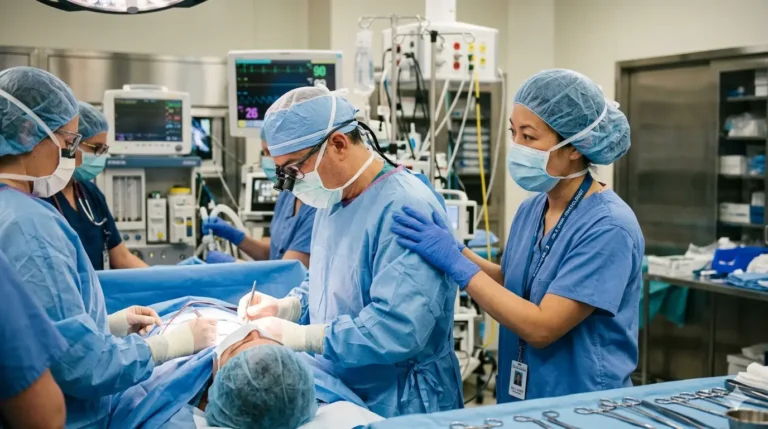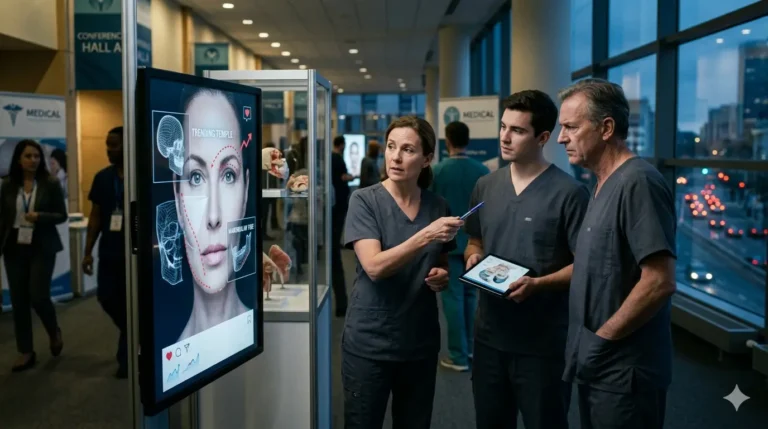
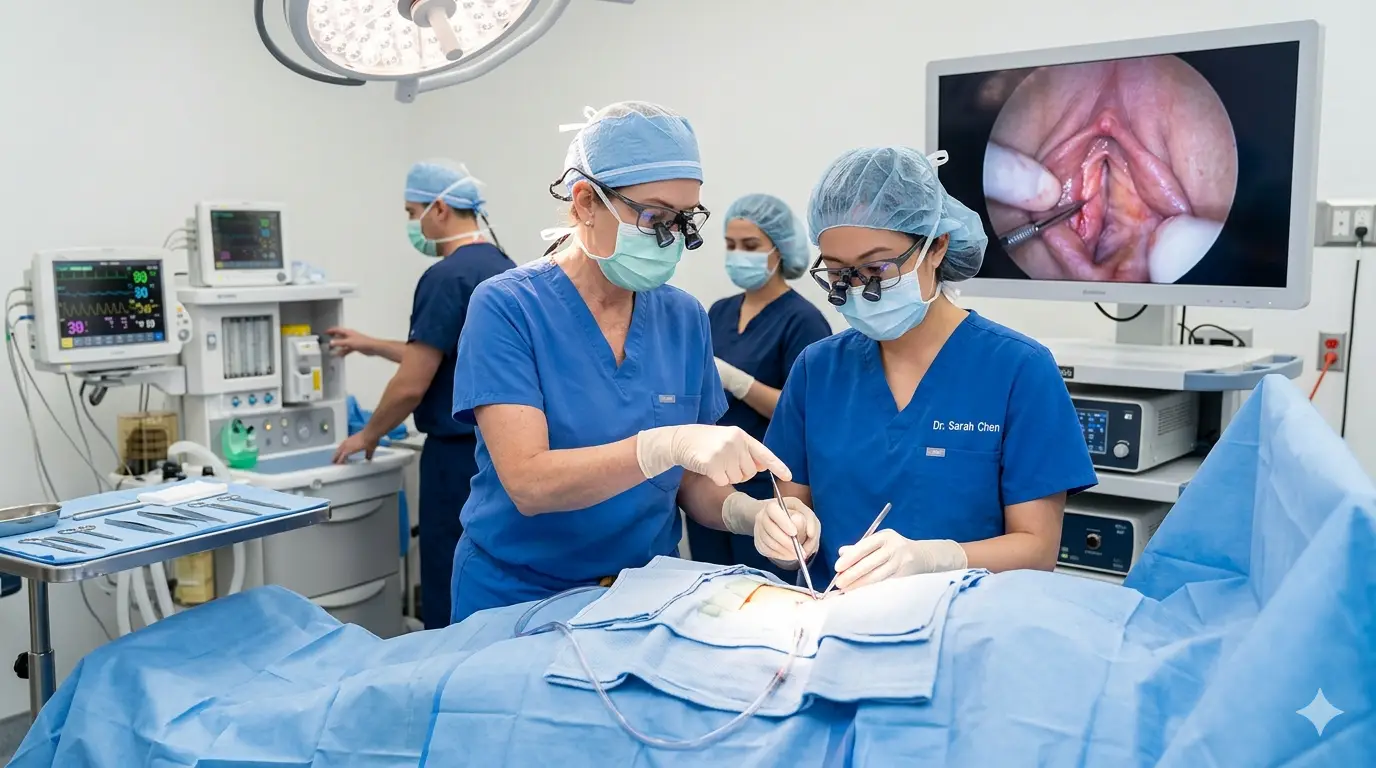

Surgical videos are useful. Simulation models are helpful. Webinars cover the theory.
None of them prepare you for what happens when you are standing in your own operating theatre, the patient is prepped, and the tissue does not behave the way it did in the video.
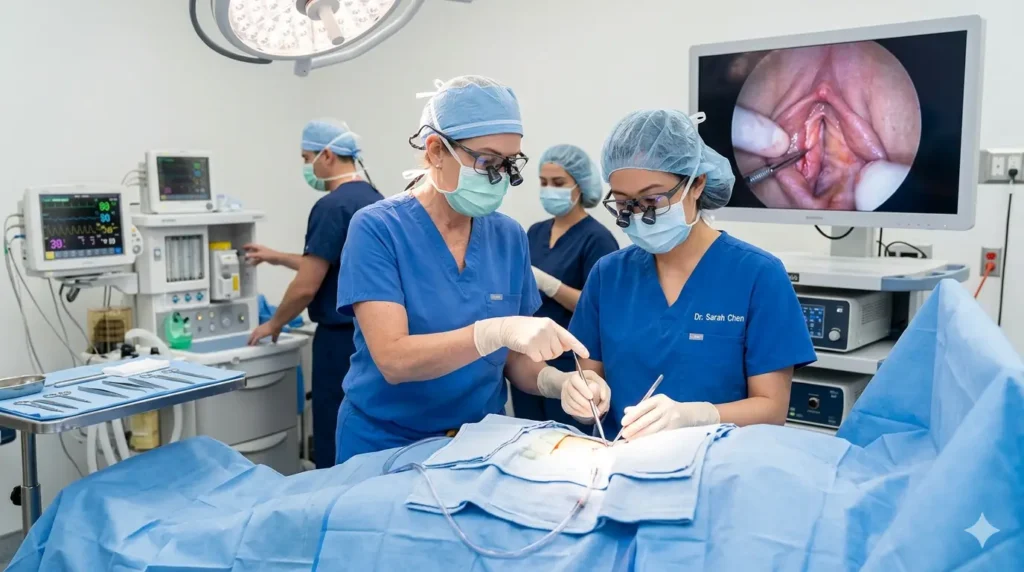
Table of Contents
1. Tactile Intelligence Cannot Be Downloaded
Cosmetic gynaecology is a tactile specialty. Success in a labiaplasty or perineoplasty depends on reading tissue tension, identifying blood supply, and making real-time judgements that no screen can transmit.
A surgical video shows you what to do. A mentored live case teaches you how tissue actually feels — under your hands, in a real patient, with real variability.
Research published in PMC on mentorship in postgraduate surgical education found that trainees who received direct, real-time mentorship during live procedures reached technical proficiency significantly faster than those who relied on simulation or video-based training alone. The mechanism is straightforward: live mentorship activates both cognitive and haptic learning simultaneously — a combination that simulation cannot replicate.
A comparative study published in the Journal of Clinical Medicine on virtual reality versus live mentorship in surgical training found that while simulation improved procedural familiarity, transfer of skill to real operative settings was significantly stronger in the live mentorship group. Simulation builds a foundation. Live mentorship builds the surgeon.
2. You Learn the Decision — Not Just the Move
Watching a master surgeon operate is not the same as watching a procedure.
It is watching a thought process unfold in real time.
Why did the expert choose a wedge resection over a trim technique in this case? Why did they switch from laser to cold blade at this specific point? Why did they pause — and what were they assessing when they did?
These micro-decisions are invisible on a pre-recorded video. They are fully visible — and teachable — in a mentored live setting, where the rationale behind every step can be explained as it happens.
The Royal College of Surgeons’ four-step approach to procedural skill learning — demonstration, deconstruction, comprehension, and performance — identifies real-time deconstruction by an expert as the critical step that bridges observation and independent execution. This step cannot be replicated asynchronously.
3. The Learning Curve Is Real — and It Has Consequences
There is a well-documented phenomenon in surgical training. A surgeon completes a short course, feels confident, attempts the procedure independently, and encounters a complication they do not know how to manage.
They saw the “what.” They did not master the “why” or the “how to recover when things go wrong.”
The learning curve in cosmetic gynaecology is real. Depending on the complexity of the procedure, proficiency typically requires between 15 and 50 supervised cases. Attempting to compress that curve by operating independently too early does not accelerate mastery. It transfers risk to patients.
4. Mentorship Teaches More Than Technique
The operating theatre is only one part of what a mentored live case teaches.
Watch an experienced specialist through an entire patient journey — from pre-operative counselling to the procedure itself to the post-operative conversation — and you learn something that no technical manual covers.
You learn how to counsel a patient whose expectations need to be gently adjusted. You learn how to maintain calm composure when an unexpected finding changes the surgical plan. You learn how to communicate a complication — clearly, honestly, and without defensiveness. You learn the language of clinical confidence.
PMC research on surgical autonomy assessment confirms that the ability to manage unexpected intraoperative findings — rather than textbook case execution — is the defining characteristic that distinguishes a competent surgeon from an expert one. This ability develops through exposure to real cases under real supervision. It cannot be self-taught.
5. The Ethics of Live Surgery — and Why It Is Still the Gold Standard
Live surgical training raises legitimate ethical questions. A patient in a training case deserves the same standard of care as any other patient. Their consent must be explicit and fully informed. Their safety must be the primary consideration at every moment.
The ethical obligation is to the patient first. A well-designed mentorship programme structures every live case so that this obligation is never compromised. The trainee learns. The patient is protected. Both outcomes are non-negotiable.
What to Look for in a Live Case Training Programme?
Not all mentored training is equal. When evaluating a programme in cosmetic gynaecology, look for:
Defined case minimums with competency assessment. The programme should specify how many supervised cases are required at each complexity level — and assess competency directly, not just count procedures.
Real-time intraoperative mentorship. The mentor should be present and actively guiding throughout the procedure — not observing from a distance or reviewing footage afterward.
Explicit patient consent protocols. Every patient in a training case must give fully informed, explicit consent to the educational element of the procedure.
Complication management training. The programme should expose trainees to how complications are identified, managed, and communicated — not only how ideal cases are performed.
Post-case structured debriefing. Immediate, specific feedback after each case accelerates skill acquisition more effectively than general end-of-course review.
The Bottom Line
Videos give you information. Models give you practice. Live cases give you mastery.
The distinction matters because in aesthetic gynaecology, the gap between information and mastery is the gap between a good outcome and a complication. Between a satisfied patient and a formal complaint. Between a practice that grows and one that struggles.
If you are serious about building a credible, safe, sustainable practice in this specialty — find a programme that puts you in the room with experienced surgeons, on real cases, with real-time guidance. That experience is not one component of your training.
It is the component that makes everything else work.