
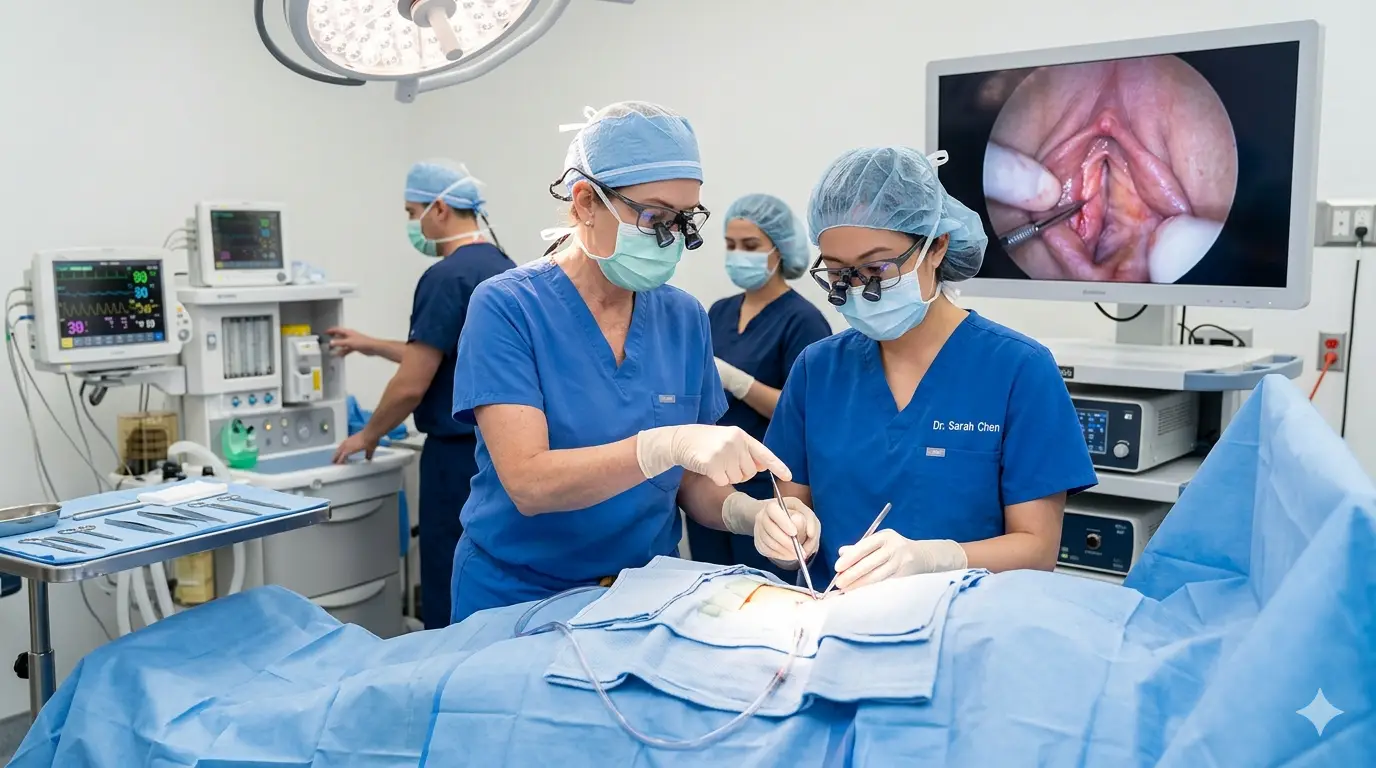

We’ve all been there. You spend hours watching high-definition surgical videos on YouTube. You attend webinars where the lighting is perfect and the anatomy looks like a textbook illustration. You might even practice on a silicone or animal model until your sutures are flawless. But then, you’re in your own OT, the patient is prepped, and suddenly… the tissue doesn’t feel like silicone. There’s a bleed you didn’t expect, or the patient’s anatomy is distorted by previous scarring.
This is the “reality gap.” And in the delicate field of Cosmetic and Regenerative Gynecology, bridging that gap safely is what separates a technician from a master. At MIRAG, we’ve always believed that while books build the foundation, mentored live cases build the surgeon.
Table of Contents
1. The “Tactile Intelligence” You Can’t Download
Cosmetic gynecology is as much an art as it is a science. When you are performing a labiaplasty or a perineoplasty, success depends on understanding tissue tension and blood supply—things that simply don’t translate through a screen.
During a mentored live case, a “Master” doesn’t just show you where to cut; they help you feel the tissue. Research consistently shows that surgical residents who train under direct, real-time mentorship reach technical proficiency significantly faster than those who rely on simulation alone.
2. Decision-Making Under Pressure
Every patient is a unique “case study.” In a live workshop, you aren’t just observing a procedure; you are observing a thought process. Why did the expert choose this specific angle for the wedge resection? Why did they switch from a laser to a cold blade in this specific zone?
Mentorship allows for “real-time feedback,” where the rationale behind every move is explained as it happens. This “deconstruction” of complex steps is what helps a trainee move from “See One” to “Do One” with actual confidence.
3. Avoiding the “Post-Workshop Disaster”
There is a known phenomenon in surgical training where a surgeon attempts a new technique immediately after a short course and encounters complications. This usually happens because they saw the “what” but didn’t master the “why” or the “how-to-fix.”
Mentored training acts as a safety net. It allows you to navigate the early part of your learning curve—which can be anywhere from 15 to 50 cases depending on the complexity—under the watchful eye of someone who has already seen every possible complication. At MIRAG, we focus on this “functional ethics”—ensuring you know not just how to start a case, but how to finish it perfectly, every single time.
4. Professional Identity and “The Master’s Touch”
Beyond the scalpel, mentorship is about professional “role modeling.” You learn how to counsel the patient pre-operatively, how to manage expectations, and how to maintain that calm, surgical “demeanor” even when challenges arise. This holistic exposure is what truly prepares you to go back to your own practice and successfully launch a new department in Aesthetic Gynecology.
The Bottom Line
Videos are for information. Models are for practice. But Live Cases are for mastery. If you are serious about transitioning into this field, don’t settle for a “look-and-learn” course. Look for a program that puts you in the room with the masters.
References & Credible Sources
- PMC / National Institutes of Health (2025). Unpacking Mentorship: A Review of Its Role in Contemporary Postgraduate Surgical Education. [On the acceleration of skill acquisition and professional identity].
- Journal of Clinical Medicine (2025). Virtual Reality vs. Live Mentorship in Surgical Training: A Comparative Study. [Analysis of “Transfer of Skill” to real-world outcomes].
- The Lancet / Global Health (2024). Surgical Education and the Learning Curve: Impact of Structured Mentorship on Patient Safety.
- PMC / NIH (2025). Comprehensive Overview of Surgical Skill Training Strategies in the APAGE International Gynecologic Endoscopy Fellowship. [The role of live patient surgery as the “pinnacle” of training].
- Journal of Orthopaedic Case Reports (2024/2025). Live Surgery: Balancing Educational Benefits and Ethical Challenges. [On real-time decision-making and “Master” insights].
- Surgical Endoscopy (2025). Standardizing Mentorship in Minimally Invasive Surgery: A Systematic Review.
- American Journal of Surgery (2024). The Cost of Competence: Evaluating the Learning Curve in Elective Aesthetic Procedures.
- ResearchGate (2026). Assessing Surgical Autonomy: Case Minimums vs. Competence in Advanced Training.
- Journal of Surgical Education (2025). Mentorship vs. Sponsorship in Academic Surgery: Navigating the Early Career Path.
- BTL / InMode Clinical Briefs (2025). Physician Training Requirements for EBDs (Energy Based Devices) in Women’s Health.
- ResearchGate / CUSUM Analysis (2026). Enhancing Outcomes and Accelerating Learning Curves: Role of Surgical Mentorship. [Quantifying the 12th to 26th case “proficiency phase”].
- Medical Education Online (2024). Real-time feedback mechanisms in live operative workshops.
- Royal College of Surgeons / Walker & Peyton (via PMC). The Four-Step Approach to Effective Learning of Procedural Skills. [Demonstration, Deconstruction, Comprehension, Performance].
- PMC / Learning Curves in Surgical Practice. Plateauing in technical skill: From novice to expert.